

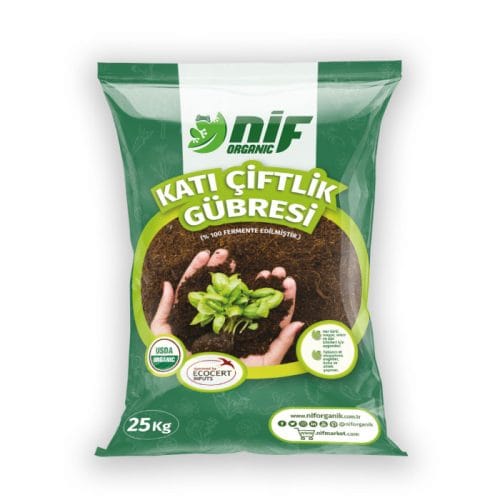
Nif Organic Fertilizer
Benefits of Nif Organic Fertilizer
Click to Order Nif Organic Solid Farm Manure.
- Organic fertilizer increases the amount of organic matter in the soil and provides multifaceted benefits thanks to the microorganisms it contains.
- Organic fertilizer regulates the physical, chemical, and biological properties of the soil and increases plant nutrients that are limited in the soil.
- Organic fertilizer increases the soil’s water retention capacity.
- Organic fertilizer regulates soil temperature, color, and water permeability.
- Organic fertilizer facilitates soil preparation and cultivation.
- In heavy soils, it loosens the tight structure formed by clay minerals, making the soil easier to cultivate and breathe.
- It promotes a stronger root system and the formation of more fibrous roots.
- It improves fruit aroma and increases product quality and yield.
- The humus within it forms complexes with clay minerals in the soil, converting nutrients like N, P, and K, which plants cannot utilize, into an available form.
- 1 kg of NIF Organic Fertilizer is sufficient instead of 10 kg of farm manure.
- Nif Organic products are produced with advanced technology and have undergone heat treatment. This ensures they hold Organic Farming (Ecocert) Certification and comply with European and American organic farming standards (NOP-EU).
- Our products are specially developed to achieve the best efficiency in all soil types and are completely natural.
FERTILIZER PROPERTIES
- Fermented at 65 °C – 70 °C.
- Sterilized against nematodes, pathogens, and fungi.
- Since it is 100% fermented, it contains no foreign seeds, harmful microorganisms, or worm/insect eggs.
- Soil, chicken, and other animal manures are not mixed.
- C/N ratio is below 20%.
- It contains nitrogen available for plants.
- Produced with advanced technology.
Organic fertilizer is a material prepared from waste or by-products of living organisms (plants, animals, etc.), containing plant nutrients in organic compounds, primarily aimed at improving the physical and chemical structure of the soil to facilitate nutrient uptake.
For years, the use of chemical fertilizers, while increasing yield, has led to soil fatigue and a decrease in vitality. For example, while 1 gram of soil should contain 27 billion microorganisms, this number has now fallen to millions and hundreds of thousands. Consequently, soils have become impoverished. It is necessary to enrich these soils again, rejuvenate them, and replenish the eroded organic matter. Organic matter supplementation is inevitable for soils. Without organic matter supplementation, soils will begin to dry out. Organic matter supplementation can be achieved through organic fertilizer.
Benefits of Organic Fertilizer
- Organic fertilizer is organic matter that retains water and oxygen in the soil.
- Organic matter is the most important factor that absorbs nutrients and accelerates microorganism activities.
- It is the most important factor for rebuilding the natural balance lost due to incorrect practices in the ecological system.
- It is the most important input for a traceable, sustainable production system for humans and the environment.
- Organic fertilizer is an alternative to eliminate the use of synthetic chemical pesticides.
- Using chemical fertilizers together with organic fertilizer reduces chemical fertilizer usage, causing less damage to the soil.
- Products grown with organic fertilizer are crucial for the benefits they provide to agricultural products offered for human consumption.
Application Method of Organic Fertilizer
- For perennial plants, organic fertilizer is applied based on tree age. For example, 1 kilogram of organic fertilizer for a 1-year-old tree, 5 kilograms for a 5-year-old tree, 8 kilograms for an 8-year-old tree, and 8 to 10 kg for trees older than 10 years. It is applied 10–15 centimeters deep around the tree’s crown projection in January, February, or March, then covered.
- For annual plants, it is applied at a rate of 300-350 kilograms of organic fertilizer per decare. For example, for products like peppers, eggplants, cotton, corn, melons, watermelons, and tomatoes, it is incorporated 20-25 centimeters deep during the final tillage (in January, February, or March).
- For annual plants (wheat, barley, rye) in dry farming: 150-200 kilograms of organic fertilizer per decare.
- For annual plants (wheat, barley, rye) in irrigated farming: 200-250 kilograms of organic fertilizer per decare, applied during the final tillage before planting.
- In greenhouses, for seedling planting, 300-350 kilograms of organic fertilizer per decare are applied during preparation.
- For potted plants, during repotting, 50-70 grams of organic fertilizer are applied per pot volume.
- For lawns, 300-400 grams of organic fertilizer per square meter are used.
Effect of Organic Fertilizer on Soil Physical Properties
- It increases the soil’s water retention capacity.
- In soils rich in organic matter, plants require less water. This prevents unnecessary water waste during irrigation.
- Organic fertilizer darkens the soil color, allowing it to absorb more heat.
- It increases soil permeability, facilitating air, water, and moisture absorption.
- It prevents salt in the soil from harming plants by moving it away from the root zone.
Effect of Organic Fertilizer on Soil Chemical Properties
- Nitrogen, phosphorus, and potassium interact effectively with humus.
- It balances the soil’s nitrogen, phosphorus, and potassium needs.
- It increases the soil’s nutrient retention capacity (cation exchange capacity).
- It ensures that plant nutrients in the soil remain in a form available for plants.
- As organic matter decomposes, it consistently converts non-storable nitrogen in the soil into nitrogen bacteria.
- It dissolves lime that water cannot dissolve, and the resulting carbon dioxide is used in photosynthesis, which is crucial for plants.
- If used with powdered sulfur, it helps reduce soil pH, which is the biggest problem in our soils.
- It converts iron, essential for plant growth, into a form that plants can absorb.
- It makes nutrients that are in an unusable form in the soil available.
- Organic fertilizer increases plant growth rate by promoting cell division in plants.
Effect of Organic Fertilizer on Soil Microbiological Activity
- It increases microbiological activity in the soil.
- It ensures that nutrient elements become available as a result of biological activity in the soil.
- It increases the microorganism population in the soil.
Fertilizers are purchased from modern farms that raise cattle in various regions. The journey of the collected fertilizers at our facility takes approximately 6 months. They undergo resting, fermentation, and maturation processes. The rested fertilizers are arranged in rows 2 meters high and 200 meters long on large concrete areas. Key considerations here are initial moisture content of 40%–65% and air temperatures above 30°C. The fermentation process involves mixing with a Topturn machine every 2-3 days. Temperatures are frequently measured, aiming for 65°C–70°C. This process continues until undesirable harmful organisms such as nematodes, pathogens, fungi, and weed seeds are eliminated. After this fermentation, the material undergoes a heat treatment system. The hygienic, sterile, and healthy fertilizers are then subjected to grinding and screening. They are transferred to bunkers at our facility and packaged into 25-kilogram bags in our filling unit, then offered to consumers. Our organic fertilizers are registered and licensed by the Ministry of Agriculture and Forestry, and certified as EU, NOP, and TR by the organic fertilizer inspection body. Organic fertilizers are produced with advanced technology. The plant nutrients, organic matter, and humic + fulvic acids they contain have significant effects on soil and plants.
Product Features
| APPLICATION AREA | APPLICATION TIME | APPLICATION METHOD |
| Greenhouse Vegetables Tomatoes, peppers, cucumbers, eggplants, melons, watermelons, pumpkins, potatoes, strawberries, onions, garlic, carrots, lettuce, celery, spinach |
Applied before planting or before the first hoeing when the soil is prepared, and mixed into the soil. | 300 – 350 kg / decare (for 2 years) |
| Open Field Vegetables Tomatoes, peppers, cucumbers, eggplants, melons, watermelons, pumpkins, potatoes, strawberries, onions, garlic, carrots, lettuce, celery, spinach |
Applied before planting or before the first hoeing when the soil is prepared, and mixed into the soil. | 300 – 350 kg / decare (for 2 years) |
| Fruit Trees Stone and pome fruit trees, citrus trees, vineyards, olives, tea, hazelnuts, figs, etc. |
Applied around the tree’s crown projection in spring and autumn, and mixed into the soil. | 5 – 8 kg / tree – January |
| Cut flowers, ornamental plants, and green areas | For cut flowers, before planting; for ornamental plants, in spring and autumn around the plant’s projection; for green areas, spread over the grass in early spring and late autumn. | 200 – 250 kg / decare (for 2 years)
350 kg / decare (for 2 years) |
| Field and Industrial Crops | Applied during soil preparation before sowing or before hoeing, and mixed into the soil. | 300 – 350 kg / decare |


